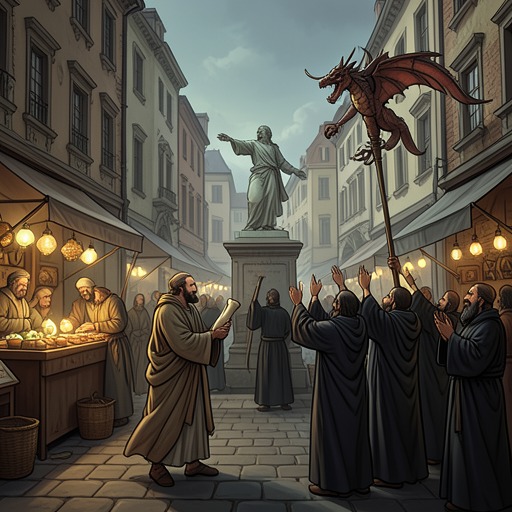
Isengrim's Seventh Commandment
Vainqueur the DragonIsengrim's Seventh Commandment is a concise rule governing the ethics of hunting under Isengrim's authority. It permits hunting to feed oneself or to thin a herd, but forbids hunting for profit, pleasure, or the extermination of a species. The commandment therefore distinguishes necessary predation from exploitative or recreational violence, while its explicit exception for demons and undead reveals the boundary of the protection it offers.
Wording and Ethical Scope
The commandment is stated as a direct prohibition with three permitted or forbidden purposes clearly separated. Hunting for food is allowed, as is thinning a herd; hunting for profit, pleasure, or extinction is not. Its logic does not condemn killing in every circumstance. Instead, it judges the purpose and scale of the hunt, treating survival and population control as legitimate while rejecting commodification, amusement, and total eradication.
The rule is presented as unusually direct among divine declarations. Chocolatine summarizes it as a command to respect the hunt, and Victor Dalton recognizes that its formulation leaves little ambiguity. The clarity matters because the surrounding social order repeatedly treats living beings according to rank, usefulness, preciousness, or edibility. Against that language of hierarchy, the commandment offers a limited principle of restraint: the fact that a creature can be hunted does not automatically make every reason for hunting acceptable.
The Explicit Exception
The commandment's protection stops at demons and undead. Those beings may be hunted for pleasure, for profit, and even to be made extinct. The exception converts a general hunting ethic into a morally divided system. It restrains violence toward at least some forms of life while declaring other categories outside the rule's concern.
That division is especially significant in a world where monsters, intelligent beings, and supernatural peoples interact as political and economic actors. The commandment can oppose wasteful or recreational hunting without establishing universal rights for all sentient beings. Its moral vocabulary remains species-based: demons and undead are not merely dangerous opponents but permissible targets of otherwise forbidden motives.
Conflict with Monster Food Ethics
The commandment is discussed while Victor Dalton faces a scheme that may involve killing him, and Chocolatine assures him that she can cure him so long as he is not dead. Victor questions whether Isengrim would approve, since he understands Isengrim as one of the nicest deities. Chocolatine answers by invoking the seventh commandment, using its exception for demons and undead to justify the proposed violence.
The exchange places the rule beside Vainqueur Knightsbane's food-chain doctrine. Vainqueur treats minions as part of his hoard and explains that, in an emergency, those lower in the preciousness hierarchy may be eaten. Victor is valued highly, even above princesses, but remains subject to the possibility of consumption if food is unavailable. Isengrim's commandment does not erase this predatory hierarchy; rather, it supplies a competing standard by which hunting can be judged according to necessity, profit, pleasure, and extinction.
The contrast becomes sharper when Vainqueur explains reproduction through hoard wealth and treats creatures that die frequently as needing to perpetuate their species. His account of breeding, food, and treasure turns life into a system of preservation and consumption at once. The commandment's ban on hunting to extinction challenges the most destructive end of that system, but its demon-and-undead exception prevents it from becoming a universal ethic of sentient life.
Relation to Sentience and Speciesism
The commandment's limitations are underscored by the debate over whether sentient beings may be eaten. Jolie states that manlings and other sentient beings have souls and that eating them or abducting their princesses is morally wrong. Vainqueur immediately exempts elves, and Victor Dalton points out that elves are people as well. This scene exposes the same structural problem found in Isengrim's rule: moral concern is recognized, but inconsistently distributed.
Vainqueur's later rejection of a fomor's extermination proposal provides another contrast. He refuses to exterminate the mortal races because they supply coins and princesses, asking where food and wealth would come from if his favorite prey disappeared. His objection is logistical and hoard-centered rather than a straightforward acceptance of the commandment. Even so, it rejects extinction for reasons that indirectly preserve the populations the commandment would forbid destroying. The result is an unstable overlap between divine restraint and predatory self-interest.
Narrative and Moral Significance
Isengrim's Seventh Commandment gives the story a formal vocabulary for distinguishing hunting from slaughter, but the surrounding characters continually test and narrow that distinction. Chocolatine uses the rule to defend violence against exempt beings; Victor hears in it a potentially humane principle; Vainqueur's food-chain worldview repeatedly treats sentient life as ranked property; and the arguments over manlings, elves, demons, and undead reveal that moral status is assigned selectively.
The commandment's decisive significance lies in this contradiction. It condemns profit, pleasure, and extinction as motives for hunting, yet authorizes all three against demons and undead. It is therefore both a restraint on predatory power and an instrument for defining who may be excluded from restraint. In the novel's broader conflict between monster civilization, divine law, and dragon appetite, the rule demonstrates that an ethical code can limit violence without escaping the species hierarchies that make violence permissible in the first place.